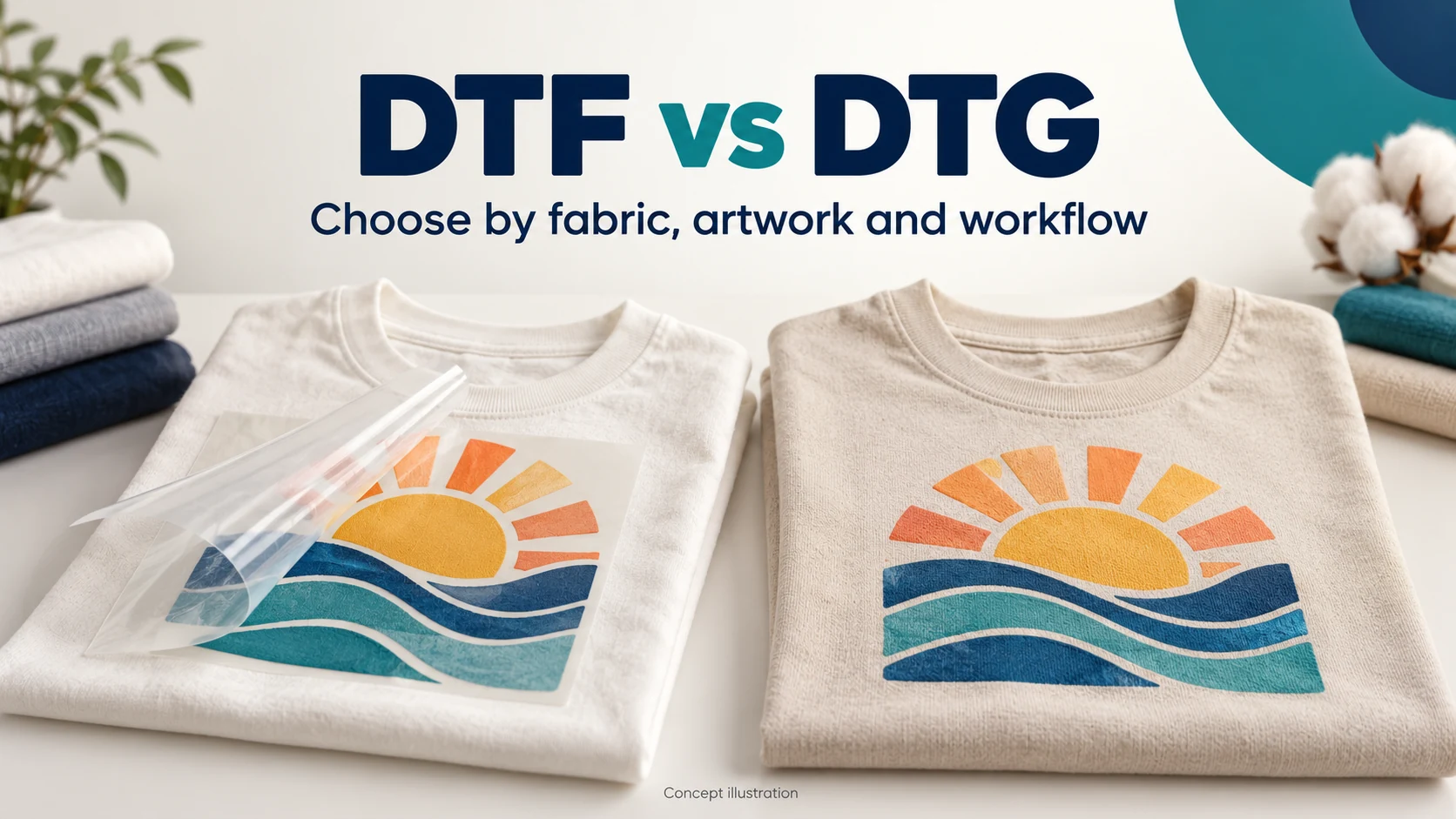
Choosing between DTF and DTG is a decision about the products you want to sell and the workflow you can operate—not a contest with one winner for every print shop.
DTF is worth evaluating for varied garment orders and transfer production. DTG is worth evaluating when compatible garments and a softer print feel are central to your range. For either method, approve actual samples before choosing equipment.
This guide compares conventional powder-based textile DTF with DTG. Textile DTF is different from UV DTF, which uses a different ink and transfer system.
DTF vs DTG: The Main Differences
| Factor | Textile DTF | DTG |
|---|---|---|
| Where printing happens | On transfer film before garment application | Directly on a loaded garment |
| Typical production route | Film printing, powder application, transfer curing, heat pressing and peeling | Garment preparation, supported pretreatment where required, printing and curing |
| Fabric selection | Broad application potential; adhesive, coatings and heat tolerance still need checking | Often a starting point for cotton and cotton-rich garments; other fabrics require supported combinations |
| Print feel | A transfer layer whose feel depends on materials and design coverage | Can provide a softer result; fabric, white underbase and ink coverage still matter |
| Artwork questions | Fine isolated details, white underbase and transparent edges need transfer-specific preparation | Fabric texture, pretreatment and underbase influence fine detail and tonal transitions |
| Production flexibility | Transfers can be prepared separately from garment application | Garments move through a direct-printing workflow |
| Cost comparison | Include film, powder, curing, pressing, cleaning, labor, and rejects | Include pretreatment, ink, curing, handling, cleaning, labor and rejects |
| Final selection | Compare acceptable finished output using your own jobs | Compare acceptable finished output using your own jobs |
1. How the Two Workflows Differ
The textile DTF process
Artwork is prepared for the supported transfer orientation, printed onto compatible film using the specified color and white layers, coated with matched hot-melt adhesive powder, and cured. The transfer is then heat-pressed onto a suitable garment. Peeling and any finishing press follow the film and consumable system’s instructions.
The carrier film is removed; it is not the permanent layer left on the garment. Film choice still influences transfer release and production handling.
Transfers can be produced before garment application, which may help with repeat designs and changing order mixes. Confirm storage conditions and usable storage time rather than assuming unlimited shelf life.
The DTG process
The garment is prepared and loaded, receives the supported pretreatment where required, is printed directly, and then cured. The exact sequence can differ between systems with separate preparation stages and integrated production equipment.
Do not copy another machine’s pretreatment, curing settings, or productivity figures into your own operating plan.

2. Fabric Compatibility: Start with the Actual Garment
For DTF, a broader range of potential applications does not remove the need for material testing. Water-repellent coatings, heat-sensitive finishes, stretch, dye migration, and uneven surfaces can affect the finished transfer.
For DTG, cotton and cotton-rich garments are common starting points. Polyester and blends need confirmation for the specific printer, ink, and pretreatment combination. Fabric structure, surface treatment, garment color, and supplier batch can matter as much as a composition label.
As an example of model-specific requirements, Epson publishes separate polyester guidance for a supported system. That is not approval of the same process on every DTG machine.
Buyer action: supply samples from your intended garment batch, including difficult colors or finishes, before approving either route.
3. Artwork, Gradients and Transparency
Both technologies can produce detailed multicolor graphics. Neither “DTF is only for simple logos” nor “DTG always prints finer detail” is a reliable equipment specification.
Distinguish a color gradient inside a printed shape from artwork that fades to transparency at its outer edge. A film-transfer workflow must resolve the white underbase and adhesive support for isolated or partially transparent details. An edge that looks correct on a monitor may need halftoning or other preparation in the supported RIP.
DTG also needs a production sample: garment texture, pretreatment and white ink can change how fine lines and soft fades appear. Minimum printable detail is specific to the full system, not a universal number.
Tapstitch’s comparison highlights transparency and line-detail decisions. Treat its service-specific examples as questions to test, rather than universal tolerances for Everpro equipment.
Ask for a sample sheet containing your small text, fine lines, tonal gradients and transparent-edge artwork, on the intended light and dark garments.
4. Hand Feel and Breathability Depend on Coverage
A small chest logo and a large solid front print should not be judged as the same application. For a transfer, reducing the solid printed area or introducing unprinted spaces can change how the garment feels and moves.
DTG can give a soft result on suitable fabric, but a dense white underbase and heavy coverage can make the print more noticeable. Avoid using a light-shirt sample to promise the same feel on a dark hoodie.
Inkthreadable discusses coverage and hand feel from its own production experience. Compare a full-size version of your intended design, not only a small demonstration patch.
5. Durability: Test Rather Than Declare a Winner
DTF adhesion can be affected by the matched adhesive, curing, pressing, garment, and care conditions. DTG performance depends on its supported ink, pretreatment, fixation, fabric, and care process.
An immediately attractive sample does not establish long-term performance. Agree on a washing and inspection procedure and record changes in color, edge adhesion, cracking, stretch recovery, and garment appearance. Set acceptance criteria for the actual use, rather than inventing a guaranteed wash count.
If prints fail, investigate the process before concluding that the technology itself is unsuitable.
6. Speed and Cost: Compare the Complete Line
Trade articles reach different speed conclusions because they describe different equipment and production arrangements. Caldera emphasizes transfer-workflow efficiency, while integrated direct-printing operations can organize preparation and curing differently. Neither description establishes a universal speed ranking.
For DTF, check transfer nesting, printing, powdering, curing, cutting, alignment, pressing, and peeling. For DTG, check preparation, loading, printing, curing and garment handling. In both cases, record cleaning, job changes, staffing, and rejected output.
Calculate two separate figures:
- Operating cost per acceptable item: relevant batch operating cost divided by acceptable finished items.
- Investment and ownership cost: equipment, software, installation, supporting equipment, maintenance and other applicable fixed costs.
For illustration, $300 of batch operating costs divided by 95 acceptable items is approximately $3.16 per acceptable item. This is not an Everpro production-cost estimate and excludes any fixed costs not allocated to the example.
A low ink-cost calculation is not a complete cost comparison. Nor does a faster printer guarantee more shipments if the heat press, curing stage, or operators are already fully occupied.
7. Maintenance and Environmental Trade-Offs
Both methods require approved consumables, nozzle checks, and the model’s maintenance and idle procedures. Automatic white ink circulation or cleaning does not mean maintenance-free operation. Include workspace, powder handling, and any specified extraction or ventilation in the installation plan.
Environmental comparisons should also use a defined scope. DTF introduces carrier film and powder-related waste; DTG can involve pretreatment and its associated handling. Both consume energy, ink, and cleaning materials and can generate rejects.
Mimaki Bompan describes these as workflow-dependent trade-offs. Neither a water-based ink description nor the absence of garment pretreatment proves that the complete process is environmentally superior.
8. Which Route Should Your Business Evaluate?
| Your situation | Start by evaluating | What to verify |
|---|---|---|
| Cotton-focused apparel range with hand feel as a priority | DTG | Full-size prints, dark garments, pretreatment and curing |
| Varied garment orders or a transfer-selling business | DTF | Fabric adhesion, heat tolerance, layout utilization and pressing capacity |
| Low or uncertain order volume | Outsourced production or purchased transfers alongside in-house options | Total order cost, turnaround, quality control and realistic demand |
| An existing print shop adding capacity | The process that addresses the current bottleneck | Acceptable output per staffed shift, installation needs and changeovers |
Startups should not assume that a small DTG printer or an entry-level DTF system is automatically the best investment. Compare outsourcing and ownership using realistic orders. Larger operations should request an acceptance demonstration using their own jobs.

Request a Sample-Based Recommendation from Everpro Print
Compare Everpro Print’s DTF printers and DTG printers. Equipment examples include the DTF-U01 two-head printer and DTG-U01 double-station garment printer. Confirm the supplied configuration rather than assuming all options are included.
Send your fabric composition and photos, artwork, largest print size, typical order size, daily output target, destination country and investment scope to sales01@everproprint.com. Ask for a sample plan and an itemized equipment recommendation.
Frequently Asked Questions
Is DTF better than DTG for small businesses?
Not for every business. Choose based on your garments, designs, order pattern, available space, and operating capability. Include outsourced alternatives if demand is not established.
Can DTF print gradients?
Yes, tonal artwork can be reproduced, but fading to transparency and very small isolated details need preparation for the supported underbase and transfer process. Approve a sample of the actual file.
Can DTG print polyester?
Some configurations support it with matched consumables and processing. Confirm the exact system; cotton-focused experience does not establish polyester compatibility.
Which method lasts longer?
There is no defensible universal winner without defined materials and test conditions. Use representative washing and handling checks.
Is textile DTF the same as UV DTF?
No. Their ink, transfer, and application systems differ. This article addresses conventional textile DTF, not UV DTF decoration.
Does a RIP solve every artwork problem?
No. RIP settings help manage output, but source artwork, supported print mode, consumables, and the garment still determine the result. Request a proof for challenging detail.