A DTF printer quotation is only one part of the investment needed to produce saleable transfers or decorated garments. The complete budget depends on the supplied configuration, supporting equipment, installation, operating workload, and the products you intend to sell.
To compare DTF printer costs, request an itemized system quotation, calculate operating cost per acceptable item, and test the result at realistic monthly order volumes. A low machine price does not automatically mean a low production cost.
This guide covers conventional powder-based textile DTF, not UV DTF.

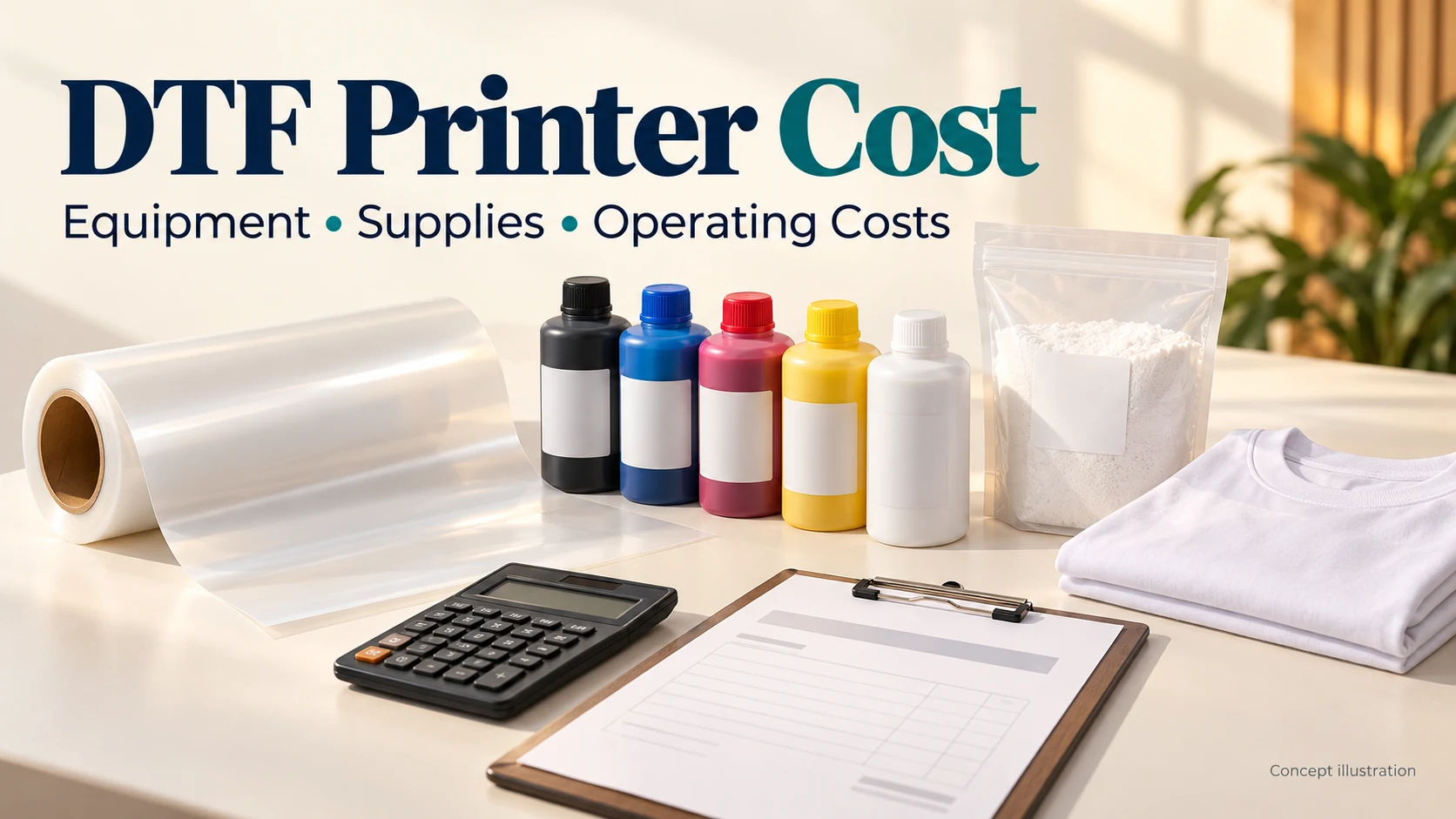
AI-generated concept illustration; no depicted item is a quoted Everpro product.
1. How Much Does a DTF Printer Cost?
Published examples range from low-thousands desktop equipment to production configurations above US$25,000. These are not like-for-like systems. A useful price answer must identify the year, market, and included equipment.
The table below provides external reference points checked on November 2, 2026—not an Everpro price list or a current market average.
| Reference | Published example | How to interpret it |
|---|---|---|
| Winnerjet’s 2025 guide | Desktop: US$1,200–2,500; A3/A2: US$3,000–6,000; industrial: US$7,000–15,000+ | Historical guide ranges, not verified current checkout prices or delivered-system quotations. |
| Kingjet USA | KJ-302A two-head printer/shaker set: US$9,990; KJ-605 five-head 60cm system: US$25,990 | Named US-market configurations. Confirm the package and destination costs. |
| Procolored’s DTF range | Desktop models with different equipment bundles | Compare the selected product variant; a printer, an oven bundle and a press bundle are different purchases. |
These references demonstrate why headline prices differ; they do not establish that one brand is cheaper or better for the same specification. Shipping, tax, installation and local support must be confirmed separately.
For Everpro Print, request a current itemized quotation for your material, artwork size, output target and destination. The useful question is: What is included, and what will it take to produce an acceptable finished item?
Which configuration should you compare?
| Equipment route | Business to evaluate it for | Main budget check |
|---|---|---|
| Compact sheet-fed or narrow-format setup | Sampling and modest, varied orders | Separate curing and pressing, operator time and maintenance capacity. |
| Roll printer with matched powdering/curing | Regular transfer or garment orders | Usable width, layout utilization and the output of the whole line. |
| Higher-output multi-head line | Established demand and staffed production | Finishing, heat-press capacity, utilities, service access and downtime exposure. |
These are selection categories, not guaranteed output levels or fixed price tiers. More printheads do not automatically mean a better purchase.

2. Build Your Budget in Three Layers
| Budget layer | Include | Question to ask |
|---|---|---|
| Initial setup and delivery | Printer, supporting equipment, software, transport, applicable import charges, installation and training | What is included in the quoted scope? |
| Operating costs | Ink, film, powder, cleaning supplies, energy, production labor, packaging and rejects | What does a representative batch actually consume? |
| Fixed costs and reserves | Applicable premises costs, licenses, planned servicing and a repair or downtime reserve | What must be paid when orders are low? |
Keep a cash budget separate from an accounting cost calculation. An equipment purchase is an initial cash outlay; depreciation spreads that cost over time. Do not count the full purchase price and depreciation as two separate costs in the same calculation. Obtain local accounting advice where needed.
3. What Equipment Is Needed Beyond the Printer?
Conventional DTF production needs a matched route for film printing, powder application, transfer curing and garment heat application. The exact equipment arrangement varies.
Epson’s equipment guidance illustrates why film, powder, and post-processing must be considered together. It is model-specific guidance, not a specification for an Everpro system.
Ask whether your quotation includes:
- The printer and its exact printhead configuration.
- Powder application and curing equipment, with any required take-up system.
- A suitable heat press if you will decorate garments.
- Licensed RIP software and the required computer specification.
- Initial ink, film, powder and cleaning supplies.
- Any specified extraction, ventilation or workspace provisions.
- Installation, operator training and the agreed acceptance demonstration.

If you sell transfers only, garment pressing may not be part of daily production. You still need a suitable way to validate transfer application and give customers supported instructions.

4. What Changes the Price of a DTF Setup?
Usable width and order layout
Compare usable print width with your artwork dimensions. A wider roll may improve layout options, but it can also require more space, supporting equipment, and operating volume. Unused film and inefficient spacing still cost money.
Configuration and production mode
Printhead arrangement, ink handling, supported print modes, and finishing capacity affect what a line can deliver. Compare samples made in the proposed production mode rather than choosing by a headline speed or printhead count alone.
Automation and staffing
Automation can change operator tasks but does not eliminate loading, alignment, quality checks or maintenance. Estimate labor from the complete job sequence and the number of operators actually required.
Support and delivery scope
Check software licensing, installation, training, spare-parts arrangements, warranty coverage and exclusions. Request the named delivery term, included freight legs, and responsibility for customs and local charges. Obtain destination-specific estimates rather than assuming a printer price is a delivered cost.
5. Calculate Operating Cost per Acceptable Item
Start with a representative artwork file and actual consumable records. Include white ink and cleaning usage, film consumed by setup and spacing, powder losses, energy, paid labor, and rejects.
For transfers, a useful formula is:
Transfer operating cost per acceptable piece = Batch operating cost ÷ Accepted transfers
For decorated garments, also include blanks, application labor, pressing, packaging and any garment losses. Make clear whether a quoted cost refers to a transfer or a finished shirt.
Worked example: a batch of transfers
The following numbers are hypothetical assumptions, not measured machine consumption, supplier prices, or an Everpro quote.
| Batch expense | Assumed cost |
|---|---|
| Film | US$18 |
| Color and white ink | US$22 |
| Powder | US$6 |
| Cleaning consumables | US$4 |
| Energy | US$3 |
| Paid production labor | US$30 |
| Batch operating cost | US$83 |
If 200 transfers are printed and 190 are accepted, operating cost is US$83 ÷ 190 ≈ US$0.44 per acceptable transfer.
This excludes garment blanks, garment pressing, packaging, delivery, fixed-cost allocation, and equipment recovery. Costs for all 200 printed transfers are already included in the batch. Do not add the same rejected-transfer material costs again as a separate expense.

6. Why Monthly Volume Changes the Result
Operating cost per piece is not the complete cost of running the business. Fixed expenses must also be supported by actual production and sales.
Assume, solely for illustration, that allocated fixed costs are US$500 per month. The allocation would be US$1.00 per accepted transfer at 500 transfers, or US$0.25 at 2,000 transfers. These figures describe allocation, not profit or a recommendation to manufacture stock without demand.
Use expected accepted output for a production-cost estimate and realistic sales for a cash-flow plan. Producing more transfers does not help cash flow if they remain unsold.
7. Buy a Printer or Purchase Transfers?
Buying transfers may suit a business with low or irregular demand, while owning a system may offer more control once orders, staffing and maintenance capacity justify it.
Compare the same product and quality standard. Purchased-transfer cost should include applicable delivery, order minimums and waste. In-house cost should include relevant consumables, labor, quality losses, and additional fixed commitments.
A simplified volume comparison is:
Monthly comparison volume = Additional in-house fixed cost ÷ (Delivered outsourced cost per transfer − In-house variable cost per acceptable transfer)
This only works when the difference in the denominator is positive, and the cost definitions are consistent. Do not double-count labor in both the variable and fixed categories. Capacity, lead times, product quality, and purchase cash requirements must also be assessed. This is not a guaranteed payback calculation.
8. Ask These Questions Before Accepting a Quotation
- Which printer configuration and accessories are included?
- Are powdering, curing, pressing, and software covered?
- Which utilities and workspace provisions are required?
- What delivery term and destination charges apply?
- Which consumables and maintenance items must be purchased separately?
- What training, warranty, and spare-parts support is included?
- Can the supplier demonstrate their own artwork and garment application?
- What sample criteria will define acceptance?
Build an Itemized DTF Budget with Everpro Print
Explore Everpro Print DTF printers, including the DTF-U01 two-head configuration, and discuss the supporting equipment needed for your workflow. A listed product is a starting point for configuration, not proof that all pictured accessories are included.
Send your artwork size, fabric details, typical order quantity, daily output target, destination country, and investment scope to sales01@everproprint.com. Ask for an itemized quotation and a representative sample test.
If you are still choosing a process, also compare DTF and DTG against your garment and print-feel requirements before committing to equipment.
Frequently Asked Questions
Is the cheapest DTF printer the lowest-cost option?
Not necessarily. Include supporting equipment, consumables, staffing, rejected output, maintenance, and delivery before comparing total costs.
How much does DTF printing cost per shirt?
It depends on artwork size, coverage, white ink, layout, consumables, labor, blanks, and reject rates. A transfer-only estimate is not a finished-shirt cost.
Does white ink circulation remove maintenance costs?
No. Follow the model’s nozzle-check, cleaning, and idle procedures and budget for the specified consumables and service items.
How quickly will a DTF printer pay for itself?
There is no universal period. Equipment cost, accepted output, actual sales, contribution per order, and downtime affect the result. Test several demand scenarios before investing.
Can I budget using a cost example from another supplier?
Use it to understand the categories, not as a forecast for your own system. Replace the assumptions with verified quotations and representative job records.